A House Designed for Hyperacusis: When Architecture Becomes Treatment explores how architectural design can protect individuals living with pain hyperacusis. The article highlights the pioneering work of Onurcan Çakır, whose “silent house” concept uses location, building orientation, layered construction, floating floors, and specialised windows and doors to minimise sound intrusion. For people who experience physical pain from everyday sounds, such environments are not a luxury but a necessity. Dr Hashir Aazh emphasises the spectrum of sound sensitivity, including hyperacusis, misophonia, and noise sensitivity, and stresses that architecture can play a crucial therapeutic role when medical treatments alone are insufficient.
Pain hyperacusis is one of the most debilitating conditions within the spectrum of sound sensitivity disorders. Individuals with this condition experience sharp, burning, or throbbing pain from everyday sounds, often at volumes far below what would be considered loud or harmful for a typical listener. For these patients, noise is not simply a disturbance but a direct trigger of physical suffering. Because no consistently effective medical treatment exists at present, environmental control becomes essential. The home itself must function not only as a place of living but also as a shield against painful sound exposure. In this sense, architecture begins to take on a therapeutic role.
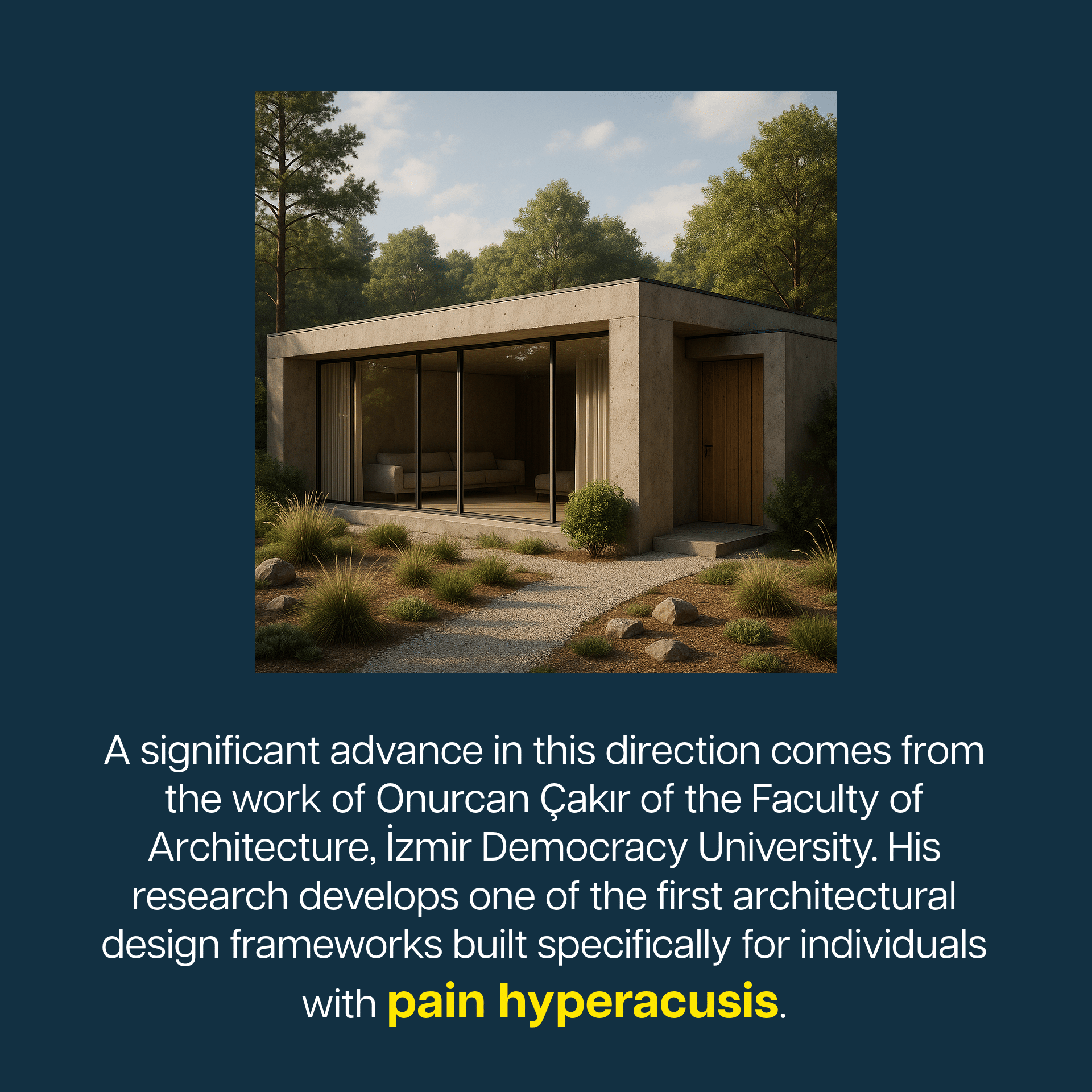
A significant advance in this direction comes from the work of Onurcan Çakır of the Department of Architecture, Faculty of Architecture, İzmir Democracy University, Turkey. His research develops one of the first architectural design frameworks built specifically for individuals with pain hyperacusis. Çakır’s work recognises that the built environment has profound implications for health, safety, and quality of life in this population, and that conventional housing standards are simply not designed for people whose auditory system reacts painfully to everyday sound.
Understanding the lived reality of pain hyperacusis requires recognising the extreme vulnerability of these patients to sound. Even minimal exposure can lead to severe setbacks lasting hours, days, or longer. Many individuals withdraw from public life because the built environment—streets, shops, workplaces, transport systems, and even typical homes—offers little protection. Everyday environments that most people navigate without thought become hazardous for someone with sound-induced pain. These patterns are seen frequently at Hashir International Institute, where patients describe the constant vigilance required to avoid harmful sound encounters.
Çakır’s research responds directly to this gap by proposing the concept of the “silent house”: a home designed from the ground up to minimise sound intrusion. The intention is not to create an aesthetically quiet home, but rather a functionally therapeutic one—a living space engineered to support the medical and psychological safety of hyperacusis patients. The idea begins with location. Rural or quieter suburban environments are naturally advantageous because they eliminate the continuous low-level noise of dense urban areas. The building’s orientation and shape are then chosen to reduce exposure to external noise sources. Even architectural geometry matters: the arrangement of façades, the distance from potential reflectors, and the relationship between the house and surrounding terrain all influence how much noise reaches the interior.
Inside the home, spatial layout is treated as a clinical matter. The quietest rooms—typically bedrooms and primary living spaces—are positioned on the most protected side of the house. Areas that can tolerate more noise, such as kitchens and storage rooms, act as buffers. Materials and construction methods are selected for their acoustic performance: layered exterior walls using combinations of concrete, brick, air cavities, and rockwool; floating floors to reduce vibration; suspended ceilings with flexible connections; and special window and door systems engineered to prevent sound leakage. Çakır documents the use of double or triple windows separated by large air gaps, heavy double-door systems, and structural decoupling strategies that collectively create an environment far quieter than conventional homes.
A real-world example of this architectural approach is the construction of a single-storey detached house designed around these principles. Such a home can achieve insulation levels significantly higher than typical residential buildings, especially in the mid- and high-frequency ranges that many hyperacusis patients find most painful. These gains are not minor refinements but essential protections. For someone with pain hyperacusis, the difference between a standard wall assembly and a clinically informed acoustic design can be the difference between unbearable daily life and the possibility of stability, rest, and recovery.
Dr Hashir Aazh, Director of Hashir International Institute, said:

“Sound sensitivity is a broad umbrella that includes a range of disorders such as hyperacusis, misophonia, and noise sensitivity. Hyperacusis itself can appear in different forms. Loudness hyperacusis occurs when ordinary sounds—people’s voices, traffic, music, household appliances—feel uncomfortably loud. Patients may also feel sensations like pressure, fullness, fluttering, or distortion in the ears. Pain hyperacusis, sometimes called noxacusis, is when those same everyday sounds cause actual physical pain, from stabbing or burning discomfort to deep aching. This pain can even radiate beyond the ears into the head, face, or neck. Importantly, this is completely different from cochlear damage. People with pain hyperacusis experience pain at sound levels far below the threshold that could cause harm. Fear hyperacusis, or phonophobia, is when individuals become afraid of sound because they believe it may hurt them, worsen their tinnitus, or damage their hearing. Alongside these conditions, we also see misophonia, where very specific sounds—often chewing, breathing, tapping, or certain speech sounds—trigger intense feelings of irritation, disgust, or anger. Noise sensitivity is another related form of sound intolerance, where a person’s general attitude toward noise leads them to feel distressed by sounds that others tolerate easily. All of these conditions can profoundly affect daily life, wellbeing, and functioning. Architecture that recognises these realities has the potential to make a real difference.”
The implications of Çakır’s work extend far beyond a single building. If sound-sensitive individuals are to participate more fully in society, architecture and urban planning must begin to recognise their needs. The silent house model challenges us to rethink the built environment as part of a broader therapeutic system—one that includes not only medical and psychological care but also the physical spaces people inhabit. Quieter public areas, quieter workplaces, and more predictable acoustic environments would significantly reduce the disability burden associated with hyperacusis.
For clinicians at Hashir International Institute, Çakır’s contribution highlights the importance of integrating environmental design into patient care. Tools such as the SSSQ2 help us identify and characterise sound sensitivity, but improving patient outcomes requires more than assessment and therapy. Many individuals cannot heal, stabilise, or maintain progress without environments tailored to their sensory needs. Architecture, therefore, becomes part of the treatment pathway. Homes built or modified according to silent house principles can protect patients from painful sound exposure, reduce flare-ups, and restore a sense of safety often lost after the onset of hyperacusis.
Çakır’s research invites a deeper collaboration between clinicians, researchers, architects, and policymakers. It advances a crucial insight: for people with pain hyperacusis, silence is not a luxury but a medical necessity. By designing environments that honour this reality, we move closer to a world in which individuals with severe sound intolerance can live with dignity, comfort, and hope.
Note: The image in this post is not a photograph of the actual hyperacusis-friendly house. It is used purely for illustrative purposes. For full details and the original specifications, please refer to the source article here.