The 2nd International Conference on Pharmacology and Gene Therapy for Tinnitus, organised by Hashir International Institute, brought together researchers and clinicians to reflect on the current and future role of pharmacological and gene-based approaches in tinnitus and hyperacusis. Rather than promoting specific treatments, the meeting focused on clarifying scientific uncertainties, exploring mechanistic diversity, and addressing long-standing challenges in translation.
Discussions emphasised that tinnitus and hyperacusis are heterogeneous conditions arising from multiple biological pathways, including altered neural regulation, stress-related modulation, neurodevelopmental differences, and pain-related mechanisms. Participants highlighted the importance of cautious interpretation of preclinical findings, improved measurement strategies, and phenotype-informed research design.
Beyond drug development, the conference underscored the value of mechanistic insight for patient education and clinical communication, even in the absence of disease-modifying treatments. Overall, the meeting reflected a maturing field that is increasingly comfortable with complexity, restraint in claims, and responsible engagement with patient expectations.
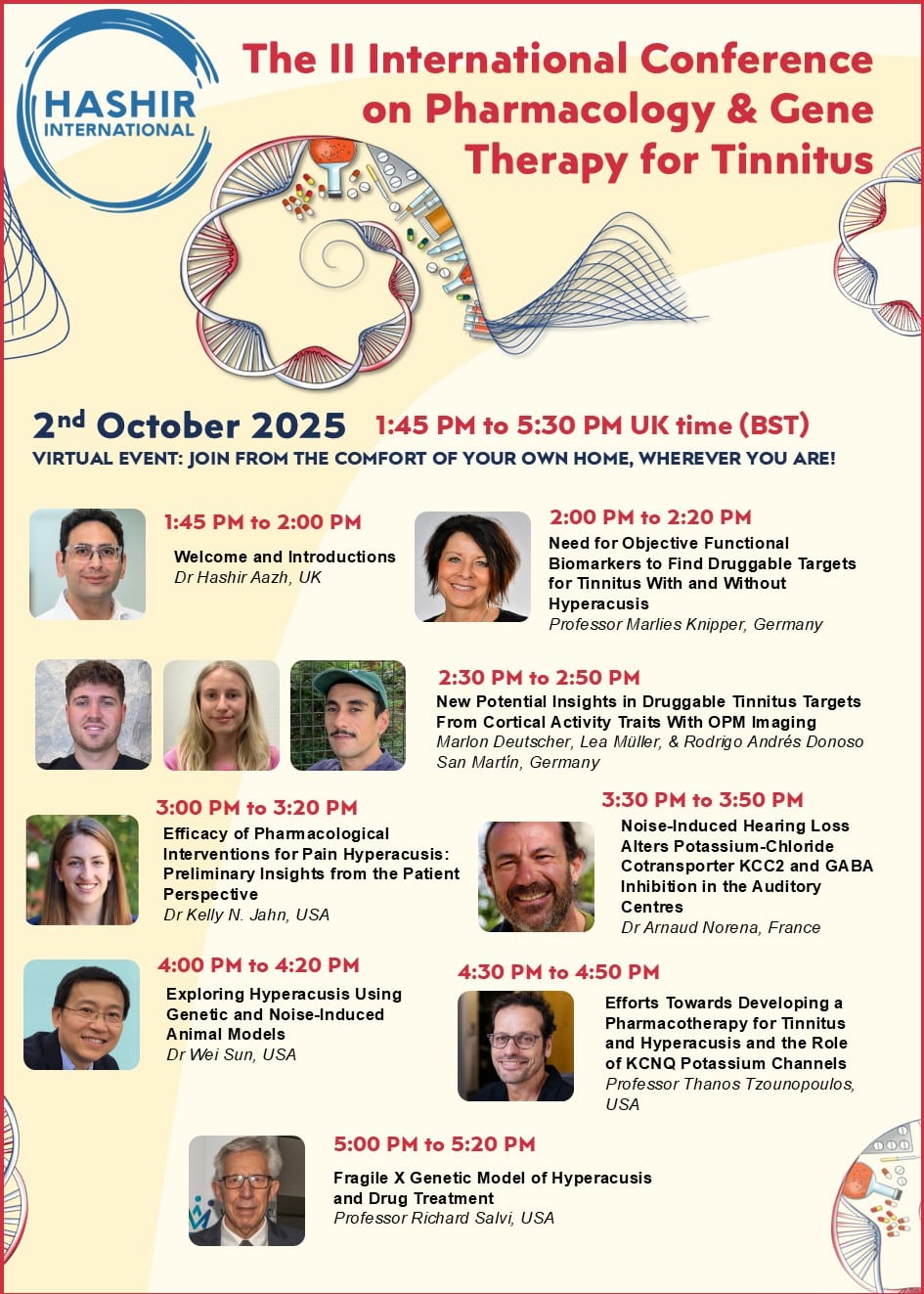
The 2nd International Conference on Pharmacology and Gene Therapy for Tinnitus, organised by Hashir International Institute and held in October 2025, was not designed to announce breakthroughs or promote imminent cures. Its aim was more reflective: to take stock of where the field genuinely stands, to surface areas of disagreement rather than gloss over them, and to ask whether pharmacology and gene-based approaches now have a clearer and more responsible place within tinnitus and hyperacusis research.
For decades, pharmacological approaches to tinnitus have occupied an uneasy position. Patients have consistently expressed a desire for treatments that go beyond coping alone, while clinicians and researchers have remained cautious, shaped by repeated trial failures and by the complexity of tinnitus as a condition that resists simple biological explanations. The result has often been a stalemate: strong demand on one side, scientific restraint on the other, and frustration in between.
What became clear over the course of the meeting is that this stalemate is slowly evolving, not because tinnitus has suddenly become easy to treat, but because the questions being asked are changing.
One of the strongest themes running through the conference was heterogeneity. Tinnitus and hyperacusis were discussed not as single disorders, but as umbrella terms covering multiple pathways, phenotypes, and lived experiences. Noise exposure, stress, neurodevelopmental differences, pain, and central nervous system plasticity all emerged as relevant factors, sometimes overlapping and sometimes clearly distinct.
This has important implications for research and care. When treatments fail in clinical trials, the conclusion is often that the treatment does not work. Yet if the underlying population is heterogeneous, failure may say less about the mechanism than about patient selection. A recurring message from the meeting was that negative or mixed trial outcomes should increasingly be interpreted as signals that stratification matters.
This does not make drug development easier. In many ways, it makes it more demanding. But it does make it more honest.
Another notable feature of the conference was the tone in which mechanisms were discussed. No single unifying theory of tinnitus was put forward, and that absence was not treated as a problem. Instead, multiple mechanistic accounts were placed alongside one another: altered inhibitory balance, changes in central gain, stress-related modulation of auditory processing, developmental differences in cortical adaptation, and nociceptive mechanisms in pain hyperacusis.
What stood out was the willingness to tolerate coexistence. Rather than competing explanations vying for dominance, these models were often presented as context-dependent, each illuminating part of a much larger and more complex picture. This pluralism may feel unsatisfying to those hoping for a single explanatory breakthrough, but it reflects the lived and biological reality of conditions that span sensory processing, emotion, attention, and learning.
Importantly, there was also restraint. Speakers were generally careful not to overextend animal findings into human claims or to imply that identifying a molecular target is the same as having a treatment. That caution set a productive tone and helped maintain trust across disciplines.
A recurring ethical tension in tinnitus care is the perceived divide between coping-based approaches and disease-modifying ambitions. This tension was present in the background of many discussions. The meeting made space for the idea that these aims operate on different timelines and address different obligations.
Supporting people living with tinnitus today through education, behavioural strategies, and psychological care addresses present suffering. Investigating pharmacological and gene-based mechanisms addresses the possibility of future prevention or modification. One does not undermine the other. Problems arise only when these aims are confused, or when early-stage science is presented as clinical reality.
By keeping pharmacology firmly within the language of investigation rather than solution, the conference avoided the kind of hype that has damaged trust in the past. This may be less exciting in the short term, but it is likely more sustainable.
Another area of discussion concerned measurement. The field still relies heavily on self-report, which is both essential and limiting. Several presentations explored behavioural, physiological, and neuroimaging approaches that might one day complement subjective measures, improve trial sensitivity, or support research with populations for whom conventional rating scales are difficult.
None of these approaches were presented as ready for routine clinical use. Instead, they were framed as part of a longer effort to better align lived experience with underlying biology, without diminishing the importance of what patients report.
Beyond measurement, there were also implications for education and communication. One of the most consistent sources of patient dissatisfaction in tinnitus care is not the absence of a cure, but the absence of clear and coherent explanations. Mechanistic models, when communicated carefully and with appropriate caveats, can help people understand why symptoms fluctuate, why stress matters, and why different individuals respond differently to the same advice.
Used responsibly, science does not only point toward future treatments; it also shapes how clinicians talk, listen, and set expectations.
If the conference demonstrated progress, it was not in the form of a new therapy or a definitive model. Instead, it reflected a shift in posture. The field appears more comfortable with complexity, more cautious about claims, and more willing to integrate multiple perspectives without forcing consensus.
That kind of progress can feel slow. But for conditions as persistent and life-altering as tinnitus and hyperacusis, slow progress grounded in realism may be preferable to rapid cycles of hope and disappointment.
The 2nd International Conference on Pharmacology and Gene Therapy for Tinnitus, organised by Hashir International Institute, did not resolve the central challenges of the field. It did something quieter and arguably more necessary: it clarified the questions worth asking, the limits that must be respected, and the responsibilities owed to patients as research continues.
From that perspective, the meeting was less about pharmacology as a solution, and more about pharmacology finding its appropriate place within a broader, multidisciplinary response to conditions that remain profoundly challenging for many people living with them.