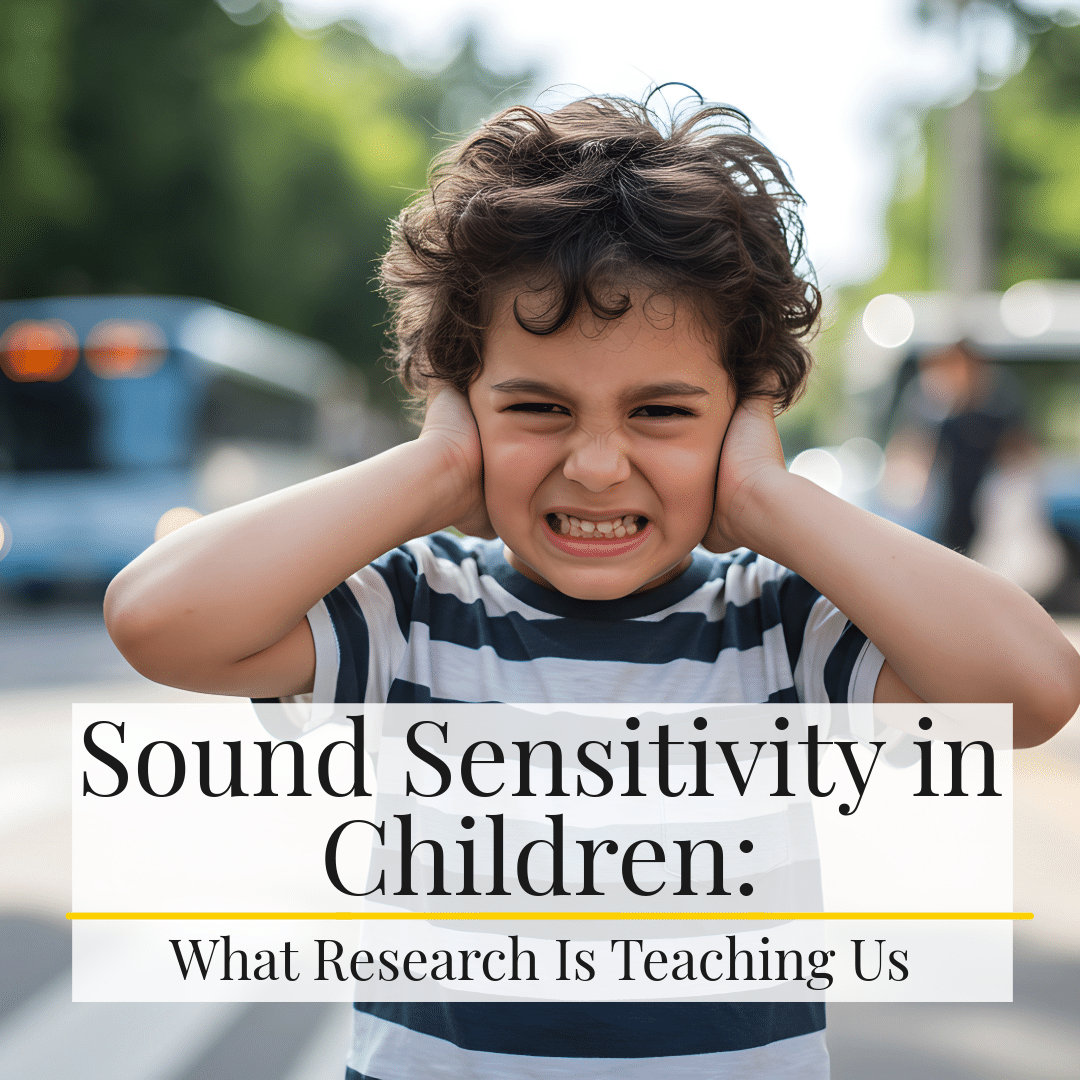
Some children find everyday sounds uncomfortable, overwhelming, or distressing. Parents often wonder whether this is just a phase, a behavioural issue, or something that needs attention. A recent research study helps shed light on how common sound sensitivity is in school-aged children and what factors may be linked to it.
In 2025, a research team led by Talita Fecchio Paulino explored sound tolerance in children aged 9 to 14 years, using reports from both children and their parents.
Sound sensitivity does occur in children
The study found that a noticeable number of children reported difficulties tolerating everyday sounds. Around one in ten children met criteria for hyperacusis based on agreement between parent and child reports. Tinnitus was also reported by around one in five children.
Although these numbers are lower than those seen in adults attending specialist clinics, they show that sound-related discomfort in children is real and present, even in community samples.
Sound sensitivity often overlaps with other sensitivities
One of the most important findings was that children with sound sensitivity were more likely to show sensitivities to light and smells. This suggests that hyperacusis in children may sometimes be part of a broader sensory sensitivity rather than an isolated hearing problem.
Interestingly, motion sickness was not consistently linked to sound sensitivity, highlighting that different sensory systems may be involved in different ways.
Age-related patterns are complex
The study also found some age-related trends:
This reinforces that sound sensitivity does not follow a simple developmental pattern and should be assessed individually rather than dismissed as something children will always “grow out of”.
Why this matters for parents and clinicians
Although the number of children with clear hyperacusis was relatively small, the study highlights an important message: sound tolerance should be considered during clinical assessment, especially when children present with distress, avoidance, or behavioural changes linked to noise.
The findings also underline the value of listening to both the child’s and the parent’s perspective. Children may describe their experiences differently, and both viewpoints help build a clearer picture.
Interpreting the findings carefully
The authors note that this was a small exploratory study and that the questionnaires used were not fully validated. This means the results should be interpreted with caution. However, the study still provides useful early evidence that sound sensitivity in children is meaningful and deserves attention.
What this means for families
For parents, this research offers reassurance that concerns about sound sensitivity are legitimate. Children who struggle with noise are not being difficult or dramatic. Their nervous systems may be responding more strongly to sensory input.
Early recognition can help avoid unnecessary distress and support children in developing healthy coping strategies rather than relying on long-term avoidance.
At Hashir Tinnitus Clinic, we take sound sensitivity in children seriously. Assessment focuses on understanding the child’s experience, sensory sensitivities, emotional responses, and daily challenges, always in a supportive and age-appropriate way.
Learn more
If you would like to read the original research paper, it is available here:
Paulino, T. F., Sanfins, M. D., Skarżyński, P. H., Scharlach, R. C., de Barros, A. C. M. P., Onishi, E. T., & Branco-Barreiro, F. C. A. (2025). Hyperacusis and associated factors in schoolchildren: An internet survey based on reports from both parents and children. Journal of Hearing Science.
https://doi.org/10.17430/jhs/211589
If you are concerned about your child’s response to sound, or would like advice on assessment and support, we are always happy to discuss this with you during an appointment.