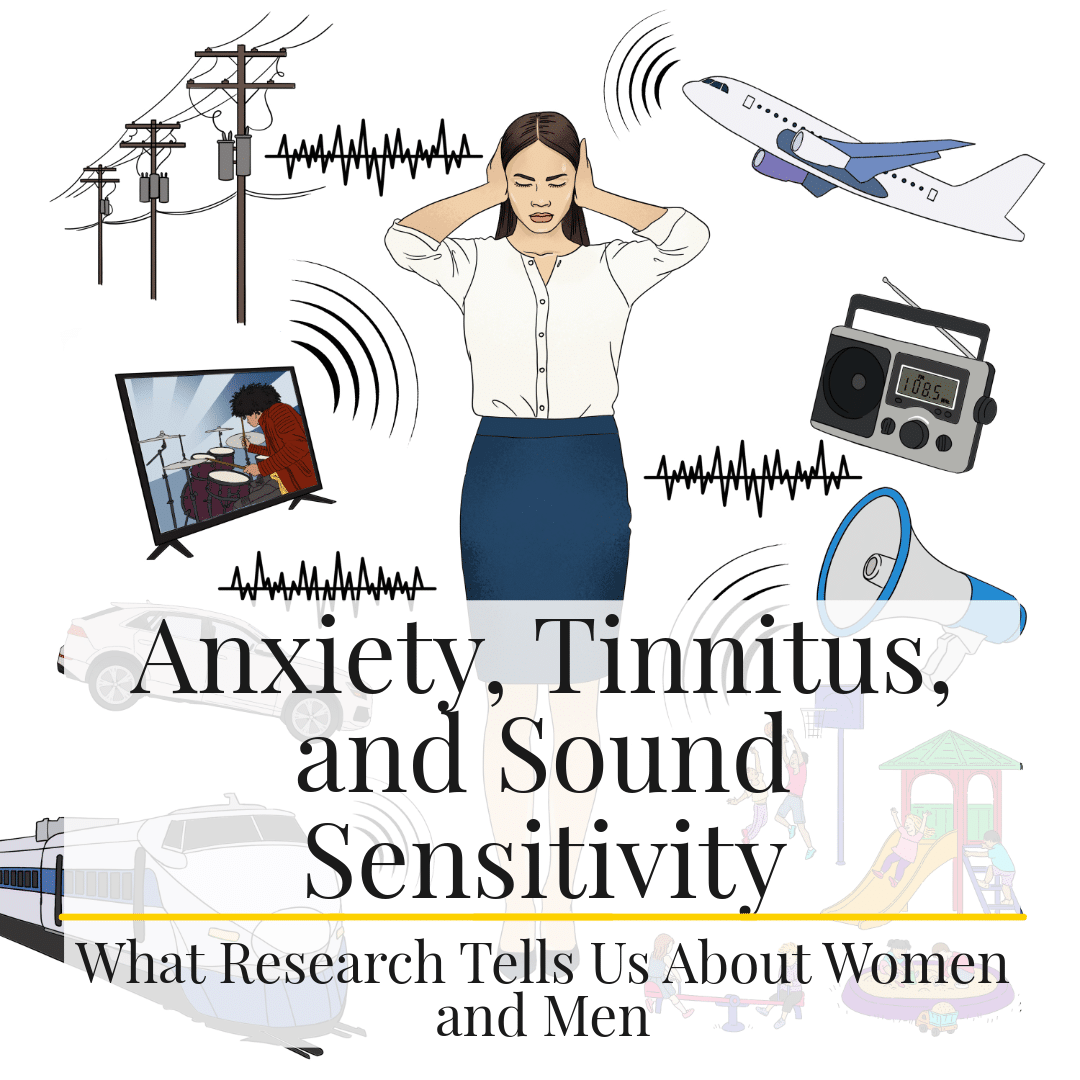
Many people living with tinnitus or sound sensitivity notice that anxiety often goes hand in hand with their symptoms. A recent research study helps clarify this relationship and explores whether tinnitus and hyperacusis affect anxiety differently in women and men.
In 2025, a research team led by Elżbieta Gos studied anxiety levels in people experiencing both tinnitus and hyperacusis. Their findings help explain why emotional distress is such a common part of these conditions and why care needs to be individualised.
Anxiety is common in people with tinnitus and hyperacusis
The study included over 100 adults with tinnitus and hyperacusis who underwent hearing assessments and completed validated questionnaires measuring anxiety, sound sensitivity, and tinnitus impact.
One clear finding was that both women and men showed anxiety levels higher than those seen in the general population. This confirms that anxiety is not a side issue. It is a central and understandable response to living with intrusive sound symptoms.
The relationship differs between women and men
While overall anxiety levels were similar in women and men, the factors linked to anxiety were different.
In women, tinnitus severity was the strongest predictor of anxiety. This suggests that the ongoing presence, intrusiveness, or impact of tinnitus plays a particularly important role in emotional distress.
In men, both tinnitus severity and hyperacusis severity were linked to anxiety. For men in this study, sound sensitivity itself appeared to contribute more directly to anxious feelings, alongside tinnitus.
These differences highlight that tinnitus and hyperacusis do not affect everyone in the same way, even when symptoms look similar on paper.
What this means for people experiencing these symptoms
This research supports several important messages for patients:
Importantly, higher anxiety levels were seen regardless of gender, reinforcing that support for emotional wellbeing is a key part of tinnitus and hyperacusis care for everyone.
Why personalised care matters
The authors suggest that treatment approaches should be tailored to the individual, rather than assuming one pathway fits all. For some people, tinnitus-related distress may be the main driver of anxiety. For others, fear and anticipation of sound exposure may play a larger role.
This supports approaches that combine:
What this means for treatment
At Hashir Tinnitus Clinic, we recognise that tinnitus, hyperacusis, and anxiety are closely linked. Treatment focuses on understanding how these interact for each individual, rather than treating symptoms in isolation or assuming the same explanation applies to everyone.
This research reinforces the importance of addressing both sound-related symptoms and emotional wellbeing as part of effective care.
Learn more
If you would like to read the original research paper, it is available here:
Gos, E., Raj-Koziak, D., Skarżyński, P. H., & Skarżyński, H. (2025). Anxiety in patients with hyperacusis and tinnitus: Differences between women and men. Journal of Hearing Science.
https://doi.org/10.17430/jhs/208806
If you would like to discuss how anxiety, tinnitus, or sound sensitivity may be interacting in your own experience, we are always happy to explore this with you during an appointment.