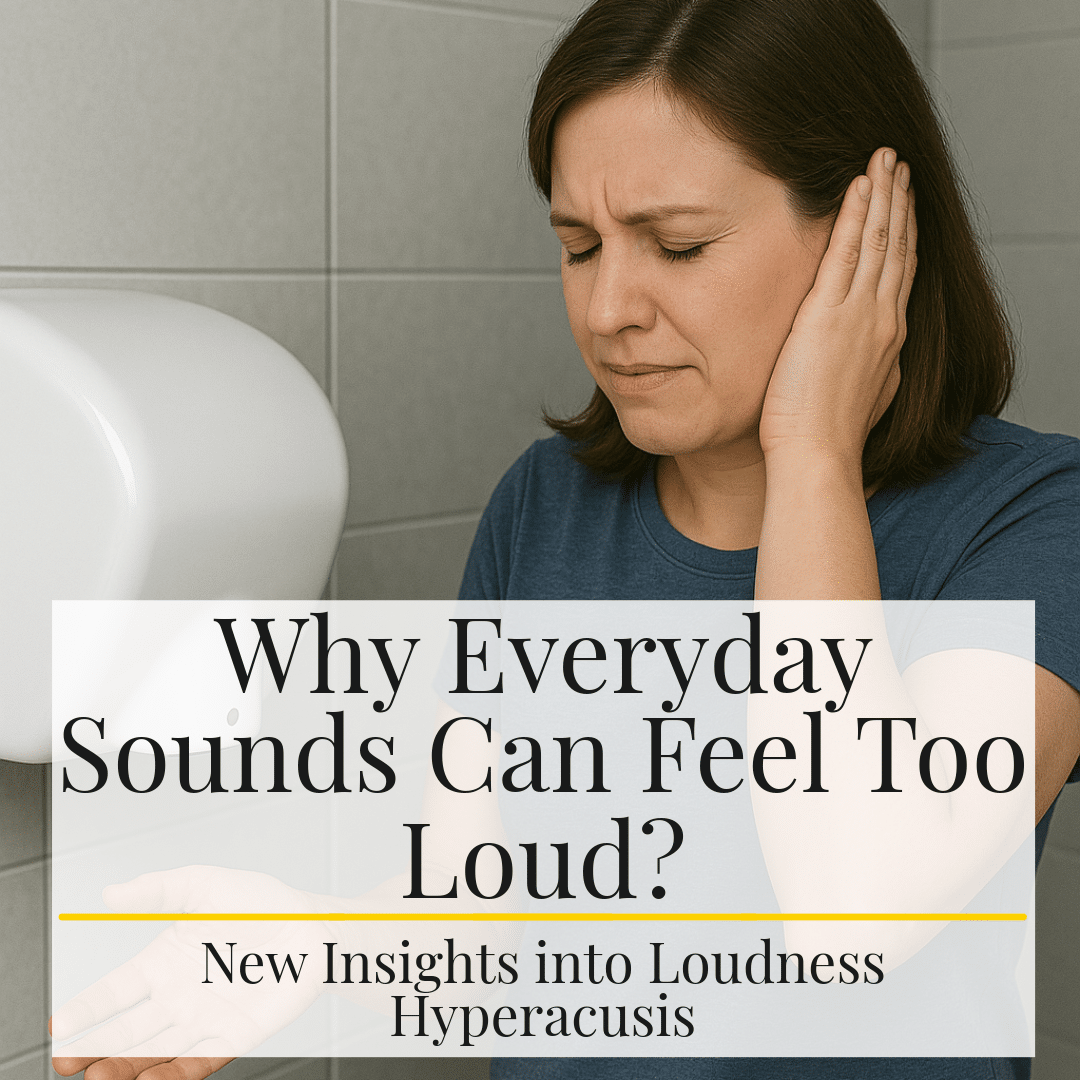
Many people with hyperacusis describe a similar experience: sounds that most people tolerate comfortably feel overwhelming, intrusive, or even painful. This can include traffic noise, dishes clattering, voices, or everyday household sounds. A recent scientific paper helps explain why this happens, even in people whose hearing tests appear normal.
In 2025, hearing scientist Brian C. J. Moore published a detailed review exploring how the brain normally controls loudness perception, and what may go wrong in loudness hyperacusis.
How loudness is normally controlled
Under typical circumstances, the brain does not simply “receive” sound passively. Loudness perception depends on a finely balanced system involving:
This system allows the brain to automatically adjust sensitivity, helping us tolerate a wide range of sounds without distress.
In people with hearing loss, this balance can change, leading to a well-known effect called loudness recruitment, where quiet sounds are hard to hear but louder sounds suddenly feel too strong.
Why hyperacusis can occur without hearing loss
One of the most important points from this research is that loudness hyperacusis can occur even when hearing tests are normal. This means hyperacusis cannot be explained by damage in the ear alone.
The paper highlights two key mechanisms that may help explain this:
The brain normally sends signals back to the ear through what is known as the efferent system. This acts like a volume control, helping dampen sound input when needed.
If this system is not working effectively, sounds may be experienced as louder and more intrusive than they should be, even at moderate levels.
The brain is highly adaptable. Following stress, injury, illness, or prolonged sound sensitivity, the brain’s sound-processing networks may become over-responsive.
Instead of adapting to repeated sounds, the brain stays in a heightened state of alert. This can amplify loudness perception and reduce tolerance over time.
What this means for people with hyperacusis
This research supports something many patients already feel intuitively:
hyperacusis is a brain-based condition, not simply an ear problem.
It also helps explain why:
Implications for treatment and recovery
Understanding these mechanisms supports modern approaches to hyperacusis care, which focus on:
The goal is not to force exposure, but to help the brain relearn safe sound processing at a pace that feels manageable.
Learn more
If you are interested in the scientific details, the original research paper is available here:
Moore, B. C. J. (2025). Loudness hyperacusis: mechanisms of loudness perception and their breakdown. Journal of Hearing Science.
https://doi.org/10.17430/jhs/204835
At Hashir Tinnitus Clinic, we use this kind of research to guide assessment and personalised treatment for hyperacusis, always taking into account both the science and the lived experience of each patient.
If you would like to discuss how this understanding applies to your own sound sensitivity, we are happy to explore this with you during an appointment.