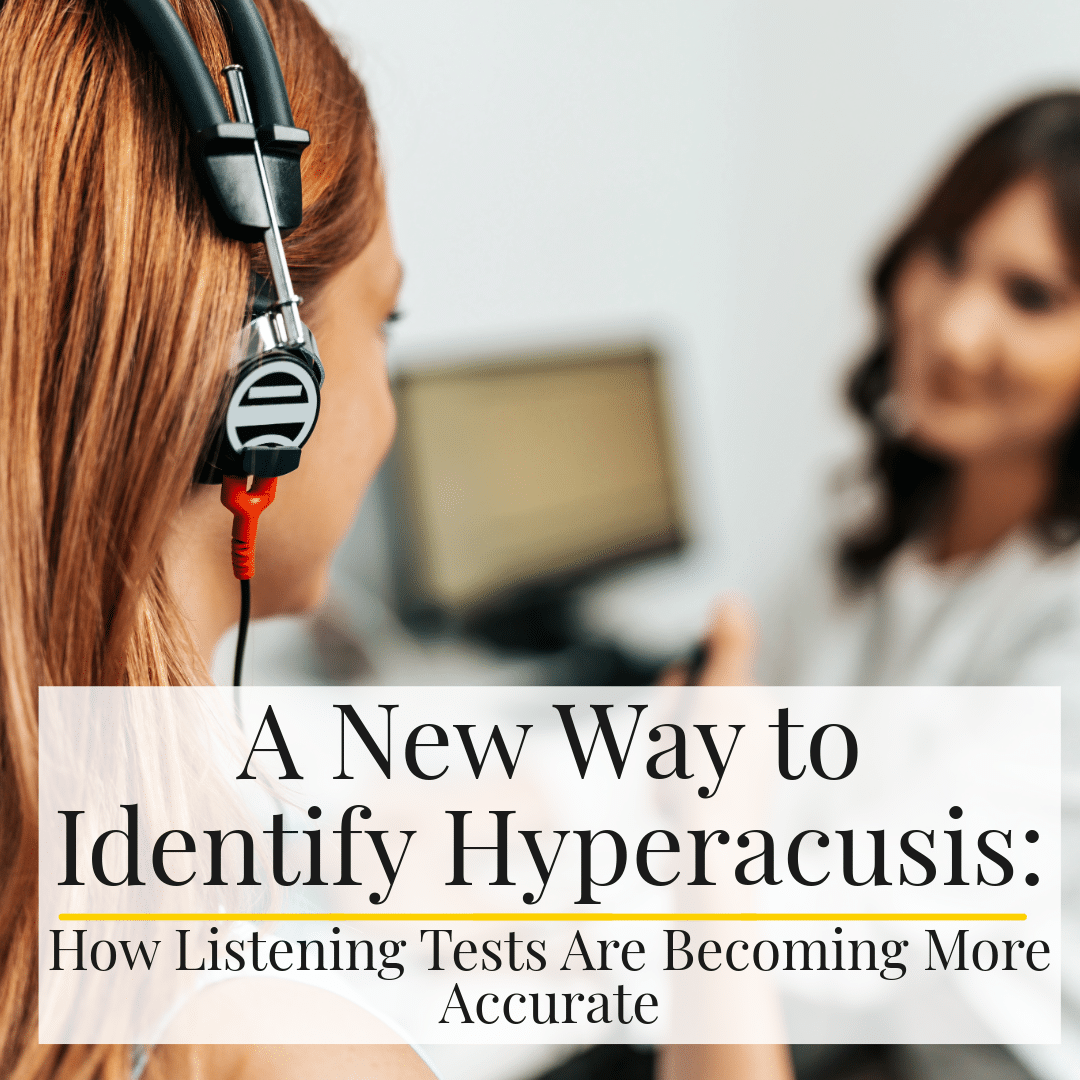
Many people with hyperacusis say the same thing: everyday sounds feel wrong, even when hearing tests look normal. Until recently, clinicians have had limited tools to objectively identify hyperacusis, relying mainly on interviews, questionnaires, and uncomfortable loudness tests that do not always reflect real-world listening.
A new study published in early 2026 offers an important step forward by validating a simple listening-based test that can reliably distinguish people with hyperacusis from those without.
The research was led by Philippe Fournier and colleagues, and published in Hearing Research.
Why diagnosing hyperacusis has been difficult
Hyperacusis affects an estimated 10 to 15 percent of people, yet there has been no widely accepted objective clinical test. Traditional measures often focus on how loud a sound becomes uncomfortable, but these tests:
As a result, people with hyperacusis may feel misunderstood or uncertain about their diagnosis.
Using everyday sounds instead of loud noises
This study took a different approach. Instead of focusing on harsh or triggering sounds, researchers used pleasant, natural everyday sounds such as environmental noises that most people would normally find comfortable.
They identified a small group of seven sounds that were particularly good at distinguishing people with hyperacusis from those without. These were called Core Discriminant Sounds for hyperacusis.
Participants listened to these sounds at moderate volume levels and rated how loud and how pleasant they felt.
Clear differences in how sounds are experienced
The results showed a consistent pattern:
This confirms that hyperacusis is primarily about altered loudness perception, rather than emotional reactions to specific trigger sounds.
A practical and realistic test
The test was delivered on a tablet and took place in a controlled but realistic listening setting. When ratings of loudness and pleasantness were combined, the test correctly identified hyperacusis in a high proportion of cases.
This means clinicians may soon have access to a tool that:
Why this matters for patients
For people with hyperacusis, this research offers important validation. It shows that sound intolerance can be measured objectively, even when hearing thresholds are normal.
It also reinforces that:
Better diagnosis helps reduce uncertainty and allows treatment to focus on the correct mechanism rather than trial and error.
What this means for care
At Hashir Tinnitus Clinic, assessment of hyperacusis focuses on understanding real-world sound experience, emotional responses, and listening behaviour. Research like this supports the move toward more precise, patient-centred assessment, helping ensure that treatment matches the underlying sound sensitivity.
As diagnostic tools continue to improve, patients can expect clearer explanations, better-targeted care, and more realistic expectations.
Learn more
If you would like to read the original open-access research paper, it is available here:
Fournier, P., Bourez, P. H., Côté, A.-S., Detroy, N., Côté, C., & Noreña, A. J. (2026). Validating and refining a psychoacoustic test to diagnose hyperacusis. Hearing Research.
https://doi.org/10.1016/j.heares.2025.109482
If everyday sounds feel uncomfortably loud or intrusive and you would like help understanding whether hyperacusis may be involved, we are always happy to explore this with you during an appointment.