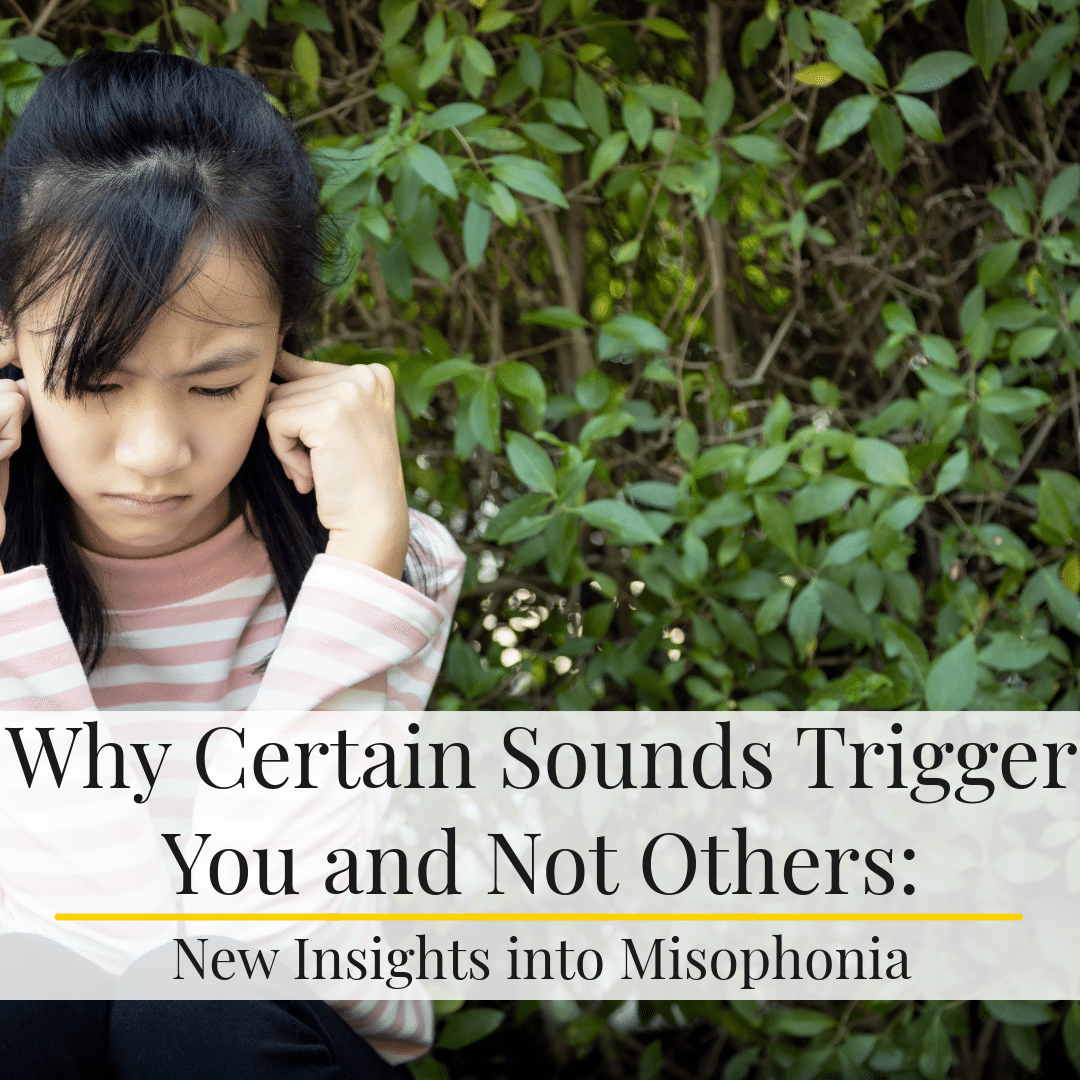
People with misophonia are often told they react to “chewing sounds” or “mouth noises,” but this description rarely captures the full picture. Many people notice that some sounds within the same category feel unbearable, while others are tolerable, and that triggers can differ widely from person to person. A new research study helps explain why.
In early 2026, a research team led by Alex C. Clonan published a study exploring how the brain processes the detailed acoustic features of sounds that trigger misophonia, and how these features can be used to predict discomfort.
Moving beyond sound labels
Rather than grouping triggers into broad categories like “eating sounds” or “repetitive noises,” this research asked a more precise question:
What exactly is it about a sound that makes it distressing for one person but not another?
To answer this, the researchers analysed thousands of sounds using detailed models of how sound is processed in the auditory system, from the ear to early brain pathways.
Identifying acoustic “fingerprints”
The study found that misophonia reactions are linked to specific acoustic patterns, such as how sound energy changes over time and across frequencies. These fine-grained features, sometimes called spectrotemporal modulations, act like an acoustic fingerprint.
Importantly:
This helps explain why misophonia feels highly personal and why trigger lists rarely apply universally.
Predicting discomfort with surprising accuracy
Using these acoustic features, the researchers built models that could predict how uncomfortable a sound would feel to a given person. These predictions explained a large proportion of people’s discomfort ratings.
In simple terms, the model could “learn” what kinds of sound patterns an individual is sensitive to and then estimate how distressing new sounds might be, even if the person had never heard them before.
Personalised understanding of misophonia
One of the most promising aspects of this research is its focus on individual differences. Instead of assuming one misophonia profile, the study shows that:
This strongly supports the idea that misophonia care should be tailored to the individual rather than based on generic trigger avoidance.
Identifying triggers in real-world sound
The researchers also demonstrated how these models could scan recordings of real-world audio, such as videos or background noise, and identify when potential trigger sounds occur.
In the future, this could help:
These tools are still research-based, but they point toward more precise and supportive approaches.
What this means for people with misophonia
This research reinforces several important and validating messages:
It also helps explain why people with misophonia often struggle to articulate why a sound feels unbearable. The brain may be reacting to subtle acoustic features that are hard to consciously identify.
Implications for care
Although this study does not test treatments directly, it supports approaches that:
At Hashir Tinnitus Clinic, misophonia assessment focuses on understanding each person’s unique sound sensitivity profile, emotional responses, and daily challenges. Research like this strengthens the scientific basis for personalised, compassionate care.
Learn more
If you would like to read the original open-access research paper, it is available here:
Clonan, A. C., Stevenson, I. H., & Escabí, M. A. (2026). Identifying the acoustic fingerprints of trigger sounds and predicting discomfort for misophonia. Hearing Research.
https://doi.org/10.1016/j.heares.2025.109478
If misophonia is affecting your daily life and you would like to explore tailored support options, we are always happy to discuss this with you during an appointment.