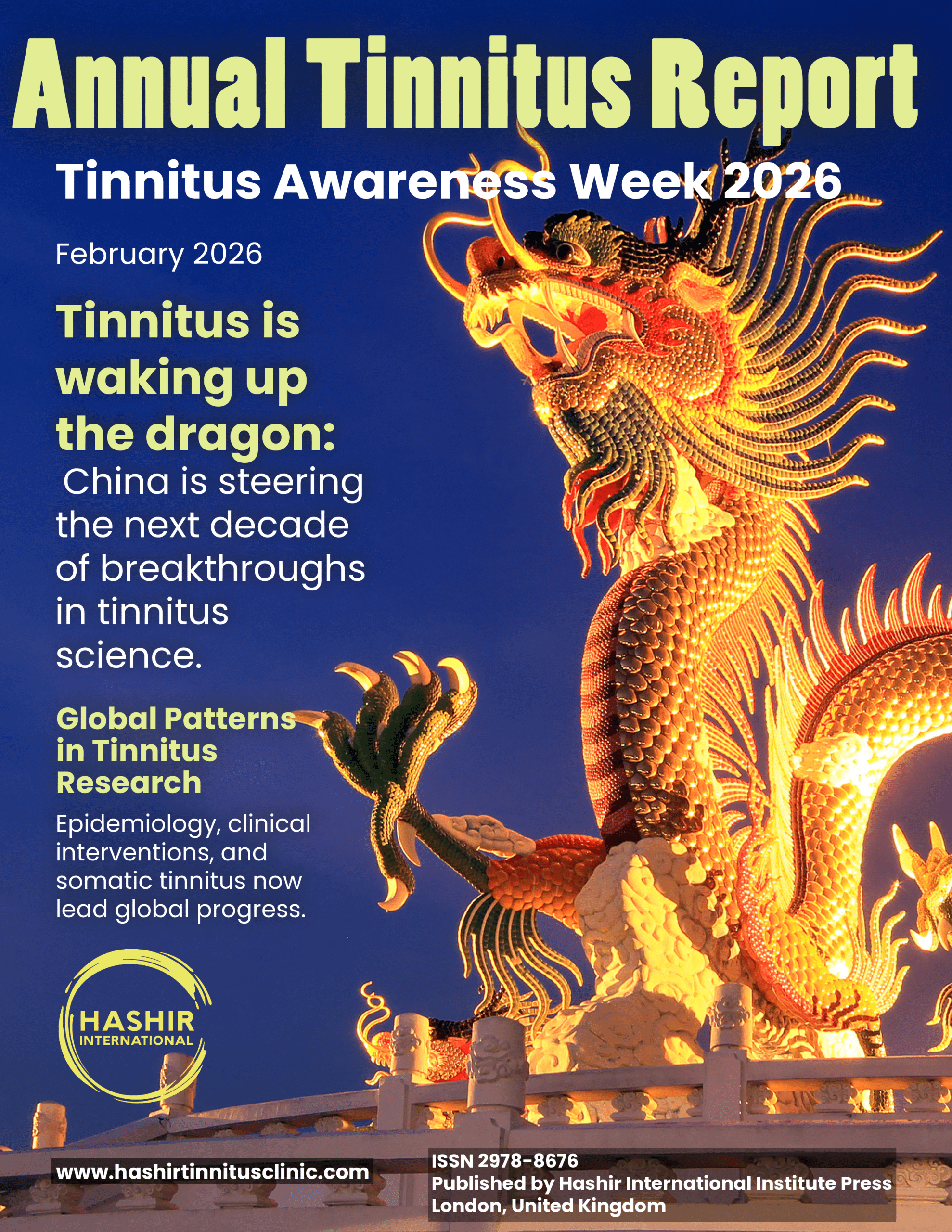
 Annual Tinnitus Report 2026
The Annual Tinnitus Report 2026 (ISSN 2978-8676) provides a comprehensive, independent overview of global scientific and clinical progress in tinnitus research published between November 2024 and October 2025. Drawing on the analysis of 446 peer-reviewed studies, expert interviews, and international perspectives, the report maps emerging themes, treatment advances, research gaps, and future directions across tinnitus, hyperacusis, and related auditory conditions.
The Annual Tinnitus Report
Volume 1
Pages 1–99
Published: 2026
Publisher: Hashir International Institute
DOI: https://doi.org/10.66080/BCTR4155
Click here to access the full Annual Tinnitus Report 2026 (PDF)
The Editorial sets out the purpose, scope, and philosophy of the Annual Tinnitus Report. It explains why an independent, global synthesis is needed, how the literature was reviewed, and how scientific progress, clinical reality, and lived experience must be interpreted together to guide future tinnitus research and care.
Click here to read the Editorial (PDF)
This article maps worldwide tinnitus research output over a twelve-month period, analysing publication volume, geographic distribution, and dominant themes. It highlights where scientific momentum is concentrated, which topics dominate the literature, and how global collaboration is shaping the evolving tinnitus research landscape.
Click here to read this article (PDF)
An in-depth exploration of China’s rapid rise as a global leader in tinnitus research. The article examines vascular mechanisms, neural circuitry, precision sound therapy, and national research strategy, arguing that China’s scale and focus may shape many of the next decade’s tinnitus breakthroughs.
Click here to read this article (PDF)
This article reviews the distinctive trajectory of tinnitus research in the United States, highlighting its emphasis on population studies, veteran health data, scalable clinical interventions, and service-delivery models. It contrasts public-health driven research with mechanistic approaches seen elsewhere.
Click here to read this article (PDF)
Professor Richard Salvi reflects on the critical role of basic auditory and animal research amid changing funding and policy priorities. The article argues that progress toward a cure depends on renewed investment in mechanistic science, improved models, and integration with translational pipelines.
Click here to read this article (PDF)
Synthesising 146 studies, this section presents tinnitus as a population-level, multisystem condition influenced by mental health, sleep, metabolic factors, ageing, and noise exposure. Anxiety emerges as a key predictor of worsening tinnitus, challenging narrow ear-centred disease models.
Click here to read this article (PDF)
A comprehensive review of 132 intervention studies covering CBT, digital therapies, hearing technologies, neuromodulation, pharmacology, surgery, and multimodal care. The article shows that tinnitus distress is highly treatable, particularly through CBT and integrated care pathways.
Click here to read this article (PDF)
In this interview, Professor Brian C. J. Moore warns that tinnitus research risks stagnation if psychoacoustic measurement continues to decline. He argues that precise characterisation of the tinnitus percept remains essential for linking mechanisms to treatment response.
Click here to read this article (PDF)
This article establishes pulsatile tinnitus as a distinct and often curable subtype. Reviewing 55 studies, it demonstrates how structured imaging can identify vascular and structural causes, with targeted surgical or endovascular treatment frequently leading to near-complete resolution.
Click here to read this article (PDF)
Professor Zhao Han outlines a precision-medicine framework integrating vascular diagnostics, personalised sound therapy, emotional regulation, and ageing research. He argues that accurate stratification determines whether tinnitus becomes persistent or remains clinically manageable.
Click here to read this article (PDF)
This section reviews advances in tinnitus measurement, prognostic modelling, and machine-learning approaches. It highlights the shift toward multidimensional profiling and the growing importance of sleep, anxiety, and distress as predictors of treatment outcome.
Click here to read this article (PDF)
Synthesising 46 studies, this article presents tinnitus as a distributed brain network condition involving altered connectivity, impaired inhibition, and limbic-auditory interactions. It reviews emerging neural biomarkers that may inform stratified and personalised treatment approaches.
Click here to read this article (PDF)
This section examines tinnitus at its biological roots, including synaptopathy, inhibitory failure, stress-sensitive pathways, and molecular targets. Findings from animal models suggest tinnitus-related neural changes are plastic and potentially reversible.
Click here to read this article (PDF)
Professor Marlies Knipper argues for renewed focus on molecular and thalamic sensory-gating mechanisms. The article connects cochlear synaptic changes to large-scale brain networks and calls for shared biomarkers to enable personalised tinnitus and sound-intolerance care.
Click here to read this article (PDF)
An interview with Dr Prashanth Prabhu examining tinnitus research and clinical care in India. The article highlights gaps in assessment tools, service infrastructure, and national coordination, while emphasising the need for precise differentiation of tinnitus subtypes.
Click here to read this article (PDF)
Professor Hui Wang describes a precision neuromodulation model using EEG-guided rTMS tailored to individual neural signatures. The article illustrates how deep phenotyping can guide targeted intervention and reduce chronicity.
Click here to read this article (PDF)
Centred on artwork by Eleanor Ponté, this reflective contribution explores tinnitus as lived experience rather than pathology. It illustrates adaptation, resilience, and meaning-making, showing how art can communicate dimensions of tinnitus beyond clinical metrics.
Click here to read this article (PDF)
This section reviews major developments in tinnitus governance, professional standards, and advocacy. It highlights evolving training frameworks, service models, and the growing role of professional bodies in shaping patient-centred tinnitus care.
Click here to read this article (PDF)
An overview of the CBT-Hear framework, a structured, multi-level training and certification pathway designed to expand access to evidence-based psychological care for tinnitus, hyperacusis, and misophonia within stepped-care models.
Click here to read this article (PDF)
A preview of the 20th Tinnitus Research Initiative Conference in Berlin, outlining its focus on mechanistic discovery, biomarkers, psychosomatic processes, and interdisciplinary collaboration to advance personalised tinnitus research.
Click here to read this article (PDF)
An introduction to the London 2027 congress themed From Mechanism to Meaning. The article presents the 11-track scientific framework and distinguished lectures designed to integrate auditory science, psychology, and clinical innovation.
Click here to read this article (PDF)
The concluding reflection situates tinnitus research within a global collaboration landscape. It argues that future progress depends on integrating mechanistic science, clinical realism, and human meaning across cultures and disciplines.
Click here to read this article (PDF)
In this invited commentary, Don McFerran offers a personal reflection on the Annual Tinnitus Report, highlighting its breadth, international scope, and clinical relevance. He emphasises steady scientific progress, growing collaboration, and the need for more precise, compassionate, evidence-based tinnitus care.
Click here to read the Invited Commentary (PDF)
How to cite this report:
Aazh H. Annual Tinnitus Report. Vol 1. Hashir International Institute; 2026. p. 1–99. https://doi.org/10.66080/BCTR4155